
Organize & group Conversations with labels
Labels let you sort, find, and manage conversations fast without building complicated folder structures. A label is a small badge made of text + color + icon that you can apply to any conversation.Why use labels
- Stay organized. Group related conversations across teams and topics.
- Work faster. Scan your inbox and spot priorities by color/icon.
- Report & review. Filter by label to see everything for a project, region, or status.
- Scope visibility. Use labels as a permission boundary. Custom roles can be set to Editor, Viewer, or No Access on specific Label inboxes. See Custom roles and permissions.
- Keep it simple. Add or remove labels anytime. No impact on message delivery.
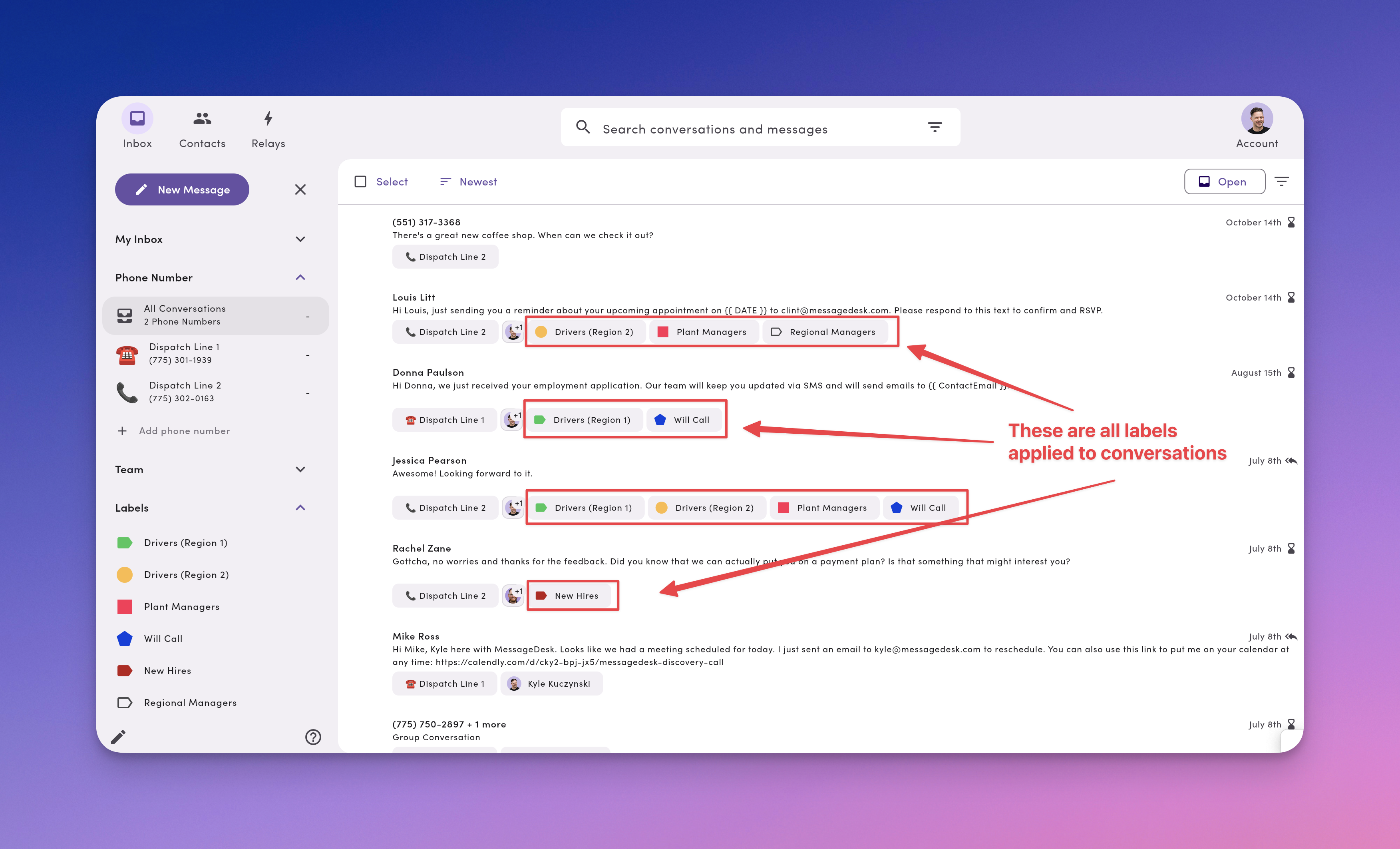
You can apply multiple labels to the same conversation.
Common label ideas (by team)
Logistics / Dispatch- Drivers. Conversations with field staff.
- Region: North / Region: South. Geographic routing.
- Urgent. Time-sensitive jobs.
- Benefits. Questions and announcements.
- New hire. Onboarding conversations.
- Support. Active cases.
- Review-ready. Happy customers to invite for a review.
- Bug. Product issues to track.
- Proposal. Outstanding quotes.
- Order. Order updates.
- Won / Lost. Quick stage markers.
Label a conversation (from the Inbox)
- Open a conversation.
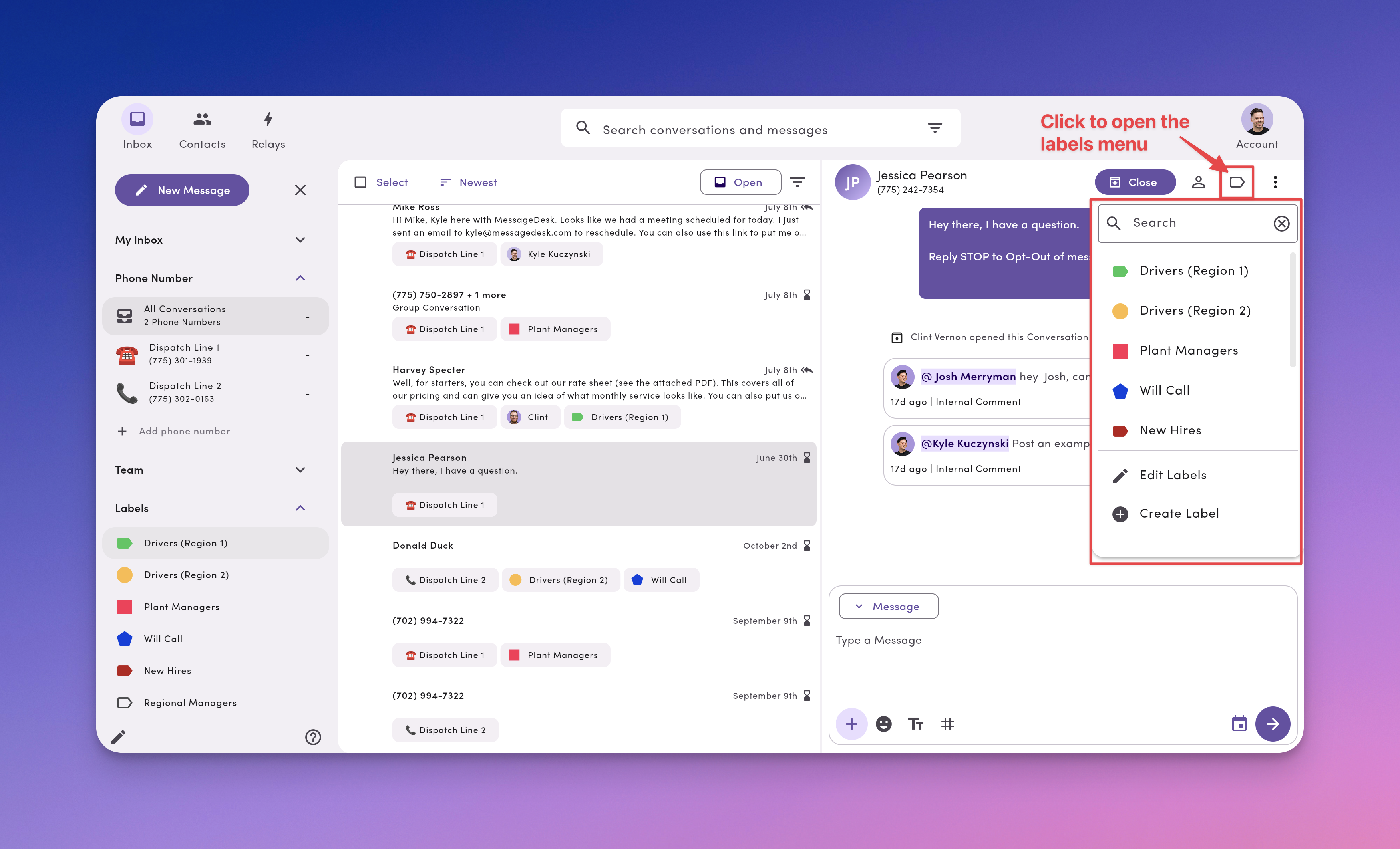
- Click the Label icon (top-right of the thread).
- Check one or more labels to apply them.
- Close the menu. The labels appear above the thread and in the conversation list.
Labels without a custom icon show a placeholder label icon in the menu.
Create & edit labels (quickly from the message thread)
- Open a conversation, then click the Label icon.
- Click Create label (or Edit labels).
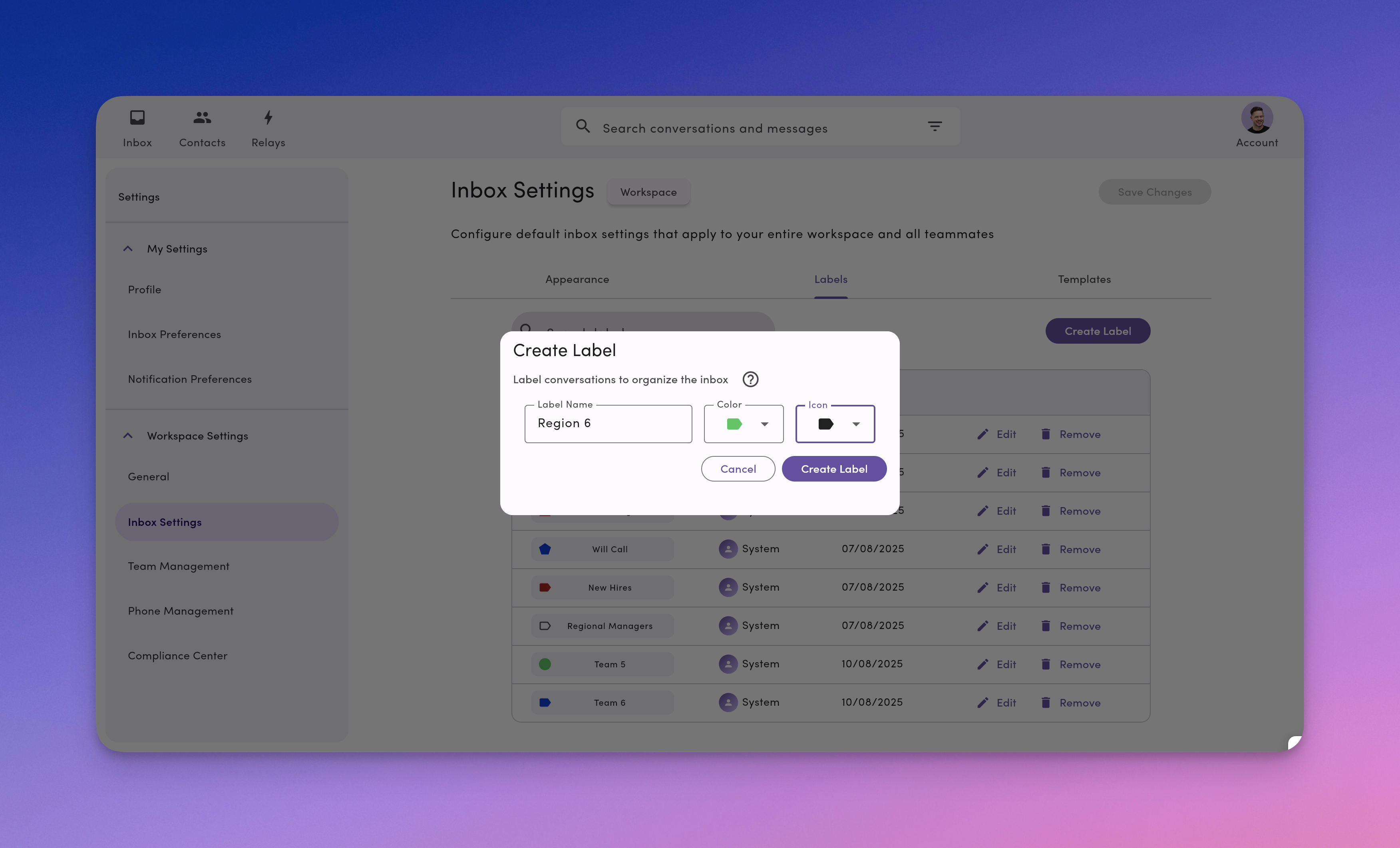
- Set Name, Color, and Icon, then click Save.
Create & manage labels (Workspace Settings)
Admins can manage labels for everyone.- Go to Account → Settings.
- Under Workspace Settings, open Inbox Settings → Labels.
- Create, rename, change color/icon, or remove labels.
Labels sort alphabetically (A–Z) by name across label menus, settings, and filters. To control where a label appears, rename it (add a prefix like
HR: or Support:).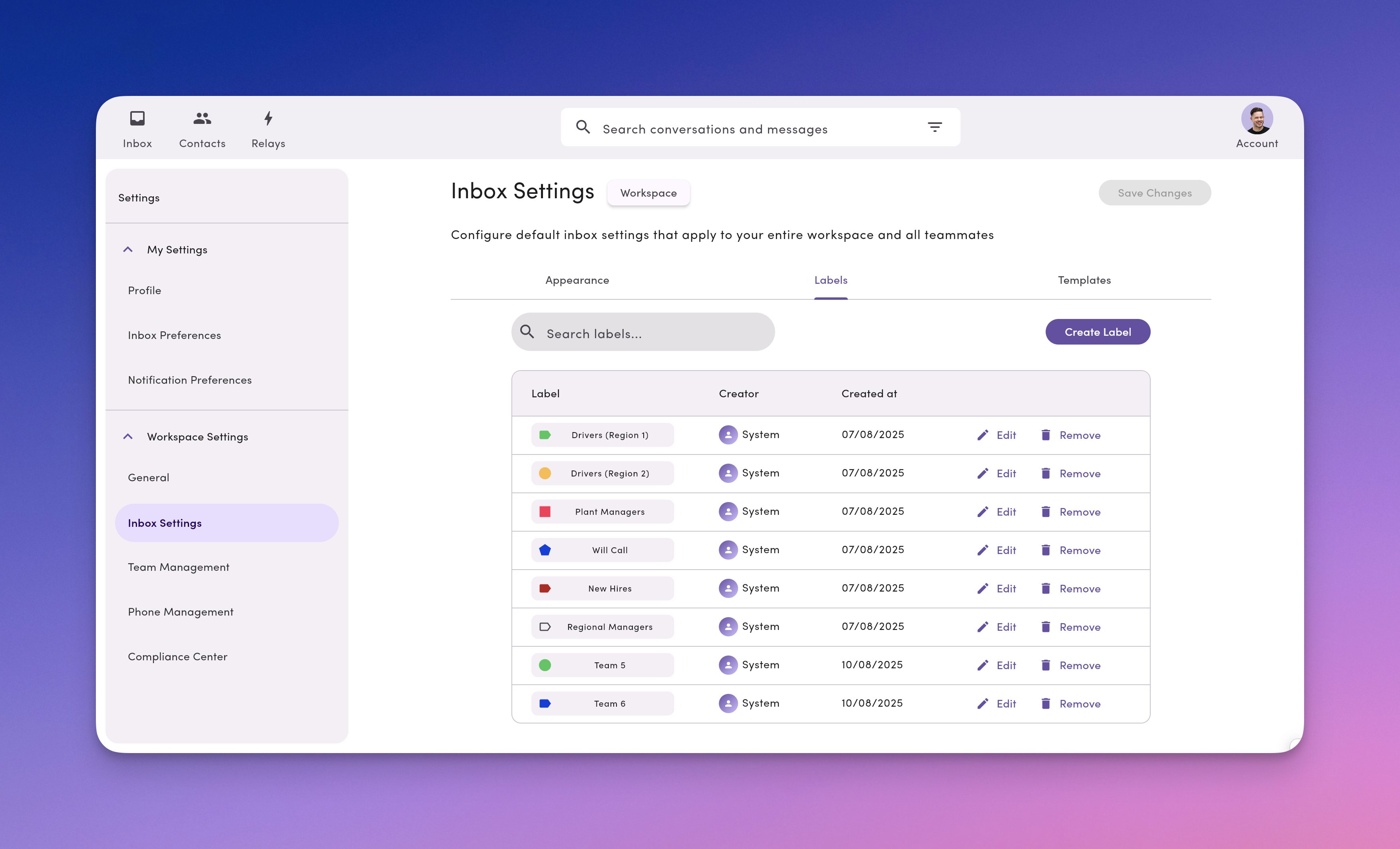
Find conversations by label
- Open your Inbox and use the filter/search to show conversations with a specific label.
- Save common filters (
Support + Urgent) as a view so your team can jump in fast.
Label naming & color conventions
- Keep it short. 1–2 words, or a word plus emoji/icon.
- Use prefixes.
HR:,Ops:,Sales:,Support:. - Color with intent.
- Green = success/ready
- Yellow = waiting/attention
- Red = urgent/blocker
- Avoid duplicates. One meaning per label name.
Support: UrgentSales: ProposalOps: Region – WestHR: New hireReview-ready
Apply labels to contacts
Labels are applied to conversations, not directly to contacts. How you apply a label depends on whether you’ve already started a conversation with the contact.If the contact doesn’t have a conversation yet
You can’t apply a label directly to a contact if no conversation exists. Instead, apply the label when sending your first message:- Start a new message to the contact.
- Select Add Action in the New Message Compose screen.
- Choose the label or labels you want to apply.
- Send your message.
If the contact already has a conversation
You have two options:- Apply the label when sending a message. Select Add Action in the New Message Compose screen and choose the label or labels you want to apply.
- Apply labels from the Inbox. Select one or multiple conversations in your Inbox and apply the appropriate labels to them. See Multi-select & quick actions.
Automatically applying labels
You can also use a Relay to automatically apply labels when a specific action or event occurs. This is helpful if you regularly need conversations labeled based on the same workflow.Labels vs. contact filters
Labels and contact filters serve different purposes in Inbox by MessageDesk.- Labels organize conversations. They can be applied when sending a message, directly from the Inbox, or automatically using a Relay.
- Contact filters organize contacts. You can filter contacts based on properties such as custom fields and save those filters for future use. A saved filter effectively gives you a reusable group of contacts that you can select and message together.
FAQ
Can I apply more than one label to a conversation?Yes. Apply as many as you need. Can I apply a label directly to a contact?
No. Labels apply to conversations, not contacts. If the contact has no conversation yet, apply the label while sending your first message with Add Action. If a conversation exists, label it from the Inbox or when sending a message. See Apply labels to contacts. What’s the difference between labels and contact filters?
Labels organize conversations in your Inbox. Contact filters organize contacts, and a saved filter gives you a reusable group of contacts to message together. See Labels vs. contact filters. Do labels affect who can see a conversation or whether messages send?
Applying or removing a label doesn’t by itself grant or revoke anyone’s access, and it never affects deliverability. But labels are a scopable resource in the permission model. A custom role can be set to Editor, Viewer, or No Access on specific Label inboxes, so an admin can restrict a role to one label and hide the rest. See Custom roles and permissions. Two things to know if you scope visibility this way:
- Assignment overrides label scope. Assigning a teammate to a conversation grants them Editor on that thread even when they have No Access to its labels. This is what makes Relay routing work, and it also means a misrouted thread is visible to whoever it landed on.
- Label scope isn’t a boundary on its own. Pair it with Phone number inbox permissions on the same role, and test with a real teammate login before relying on it.
Yes. Edit the name/color/icon anytime from Inbox (Label menu) or Workspace Settings. Deleting a label removes it from every conversation. You can also multi-select and delete multiple labels at once from Label Settings. Can I filter by more than one label at a time?
Yes. Combine labels in a filter to narrow your view (
Support + Urgent).
Can I label an anonymous conversation?Yes. Anonymous conversations (phone numbers not saved as contacts) can be labeled the same way as identified ones, both manually from the Label menu and automatically through Relays. Labels stay on the conversation if the anonymous number later becomes a saved contact.
Troubleshooting
- I don’t see the Label icon.
Make sure you’re inside a conversation, not just the inbox list. If it’s still missing, check your workspace permissions. - I created a label, but teammates can’t find it.
Ask them to refresh the inbox. Confirm you created it in Workspace Settings if it should be available to everyone. - We have too many similar labels.
Standardize names with prefixes, merge duplicates (rename to the preferred label, then archive the old one), and document your naming rules in a short internal note.