

How to automate with Relays
Relays are MessageDesk’s workflow engine. They listen for events, evaluate conditions, and run actions so the right conversation reaches the right person at the right time.Why use Relays?
- Scale without chaos: Auto-assign and auto-label to keep your Inbox tidy as volume grows.
- Respond faster: Send after-hours and first-touch replies automatically.
- Reduce busywork: Route by phone line, label, or teammate so work starts in the right place.
- Stay consistent: Standardize rules so you don’t miss handoffs.
Relays or Zapier? Start with Relays when the whole workflow lives in MessageDesk. They’re first-party, go deeper into the product, and don’t depend on an outside account. Reach for Zapier when you need to touch another app, or when you need branching, filters, and multi-step logic. The two share a vocabulary on purpose, so what you learn in one carries over.
What you can do with Relays
Relays cover four kinds of work:- Answer without a person. After-hours replies, keyword replies, and a first-touch question for texts from unsaved numbers.
- Get the thread to the right owner. Route by phone line, keyword, label, or contact property. Assign the first teammate who replies. Reset assignment when a thread closes or reopens.
- Keep the Inbox honest. Auto-label, auto-close threads nobody needs to touch, and force a thread back to Unread so an auto-reply doesn’t look like a handled conversation.
- Talk to your other systems. Push messages, closes, assignments, and opt-outs out by webhook. Let a CRM or form send a webhook in and text a contact through MessageDesk.
How Relays work (at a glance)
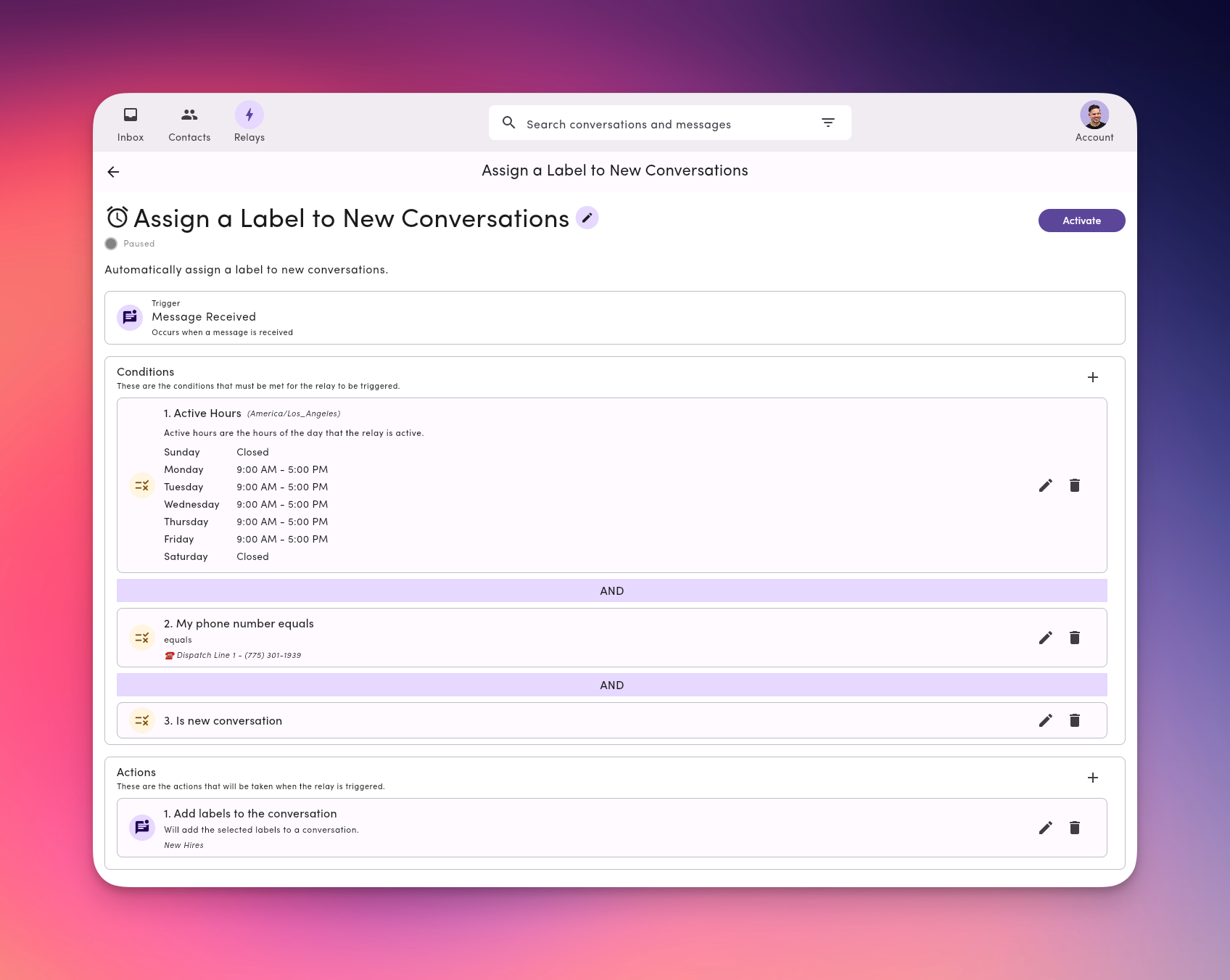
- Triggers decide when a Relay runs. Fourteen of them, from Message Received to Opt Out Created.
- Conditions decide where and when it applies: a phone line, a keyword, a label, an assignee, a time window.
- Actions are what happens: reply, assign, label, open or close the thread, post an internal comment, send a webhook.
Multiple Relays on one event. When several Relays share the same trigger, all matching Relays run in the Order you set on the Relays list, top to bottom. Reorder Relays to control sequencing when conditions overlap. For example, run a specific keyword auto-reply before a generic after-hours reply. See Order your Relays.
Relay templates
MessageDesk ships 58 templates, grouped by outcome in the app. Every one arrives paused, so nothing runs until you turn it on.An auto-reply isn’t a handled conversation. A Relay reply moves the thread to Replied, which takes it out of the Unread filter, but nobody has read it yet. See Relays and conversation status.