

Documentation Index
Fetch the complete documentation index at: https://docs.messagedesk.com/llms.txt
Use this file to discover all available pages before exploring further.
Custom Fields: Organize Contacts and Send Smarter Messages
Custom fields let you save the contact details that matter. Think region, location, membership type, assigned rep, renewal month, program, or any other contact detail you need to track. That matters because once the data is on the contact, you can use it. You can filter contacts by a custom field, save that filter as a reusable list, and come back to it anytime. Then you can select that group and send the right message to the right people. Custom fields turn contact data into action.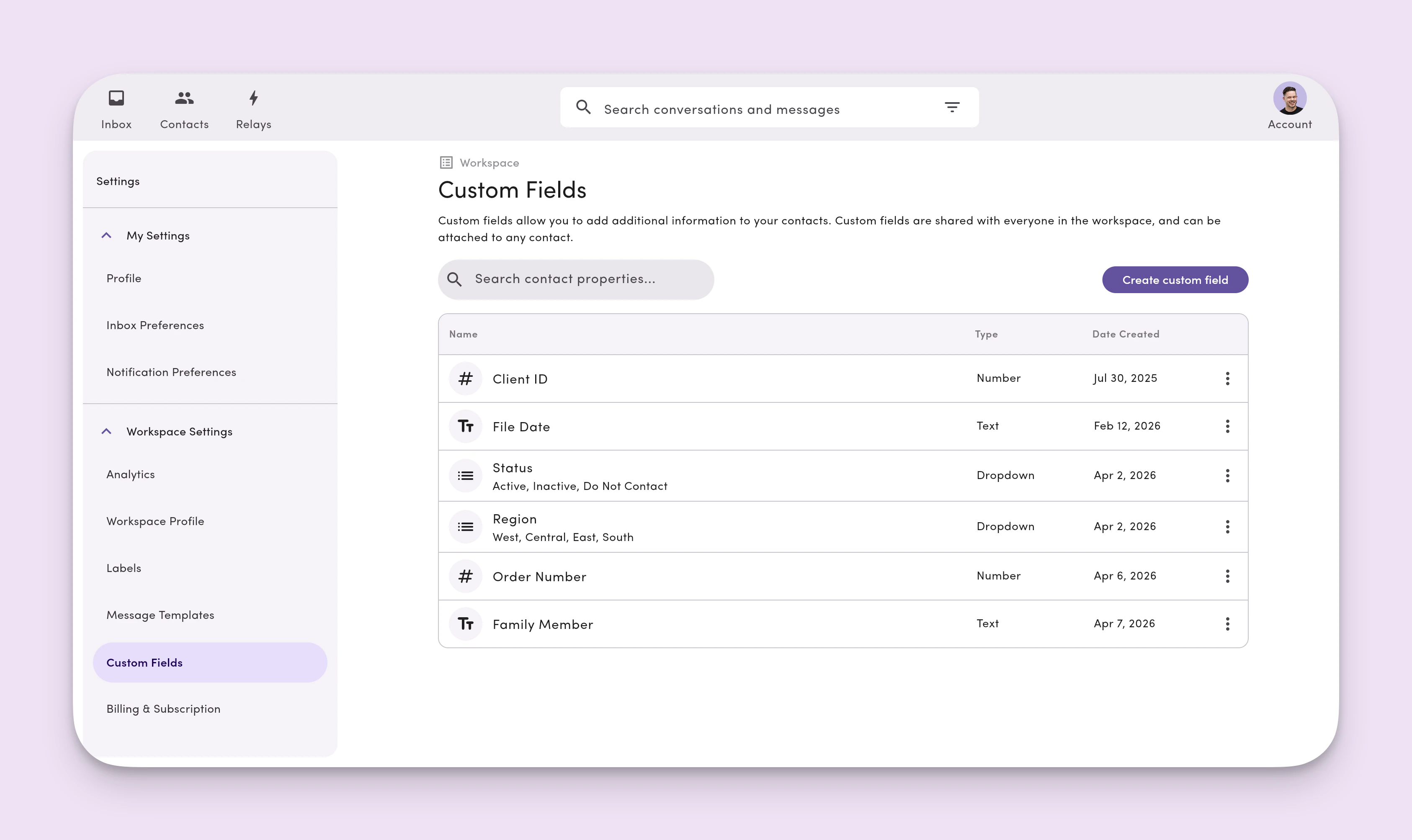
What are custom fields?
A custom field is a contact field you create yourself. Use custom fields when the default contact fields aren’t enough for how your team works. They help you track the details you care about, keep contacts organized, and build reusable groups for outreach. For example, you might create custom fields for:- Region
- Store location
- Customer type
- Assigned rep
- Renewal month
- Membership status
- Campus
- Lead source
Why custom fields matter
Custom fields help you do more than store data. They help you group contacts in a way that matches your business. Once that data is saved, you can:- filter contacts by a specific field value
- save that filter as a reusable list
- return to that list anytime
- select contacts in that list
- send a message to that group fast
Access custom fields
- Click your profile icon (top-right).
- Select Settings.
- Under Workspace Settings, click Custom Fields.
Don’t see Custom Fields? Your role may not include access. Ask an Admin or Manager to adjust your permissions.
Create a custom field
- Go to Settings → Workspace Settings → Custom Fields.
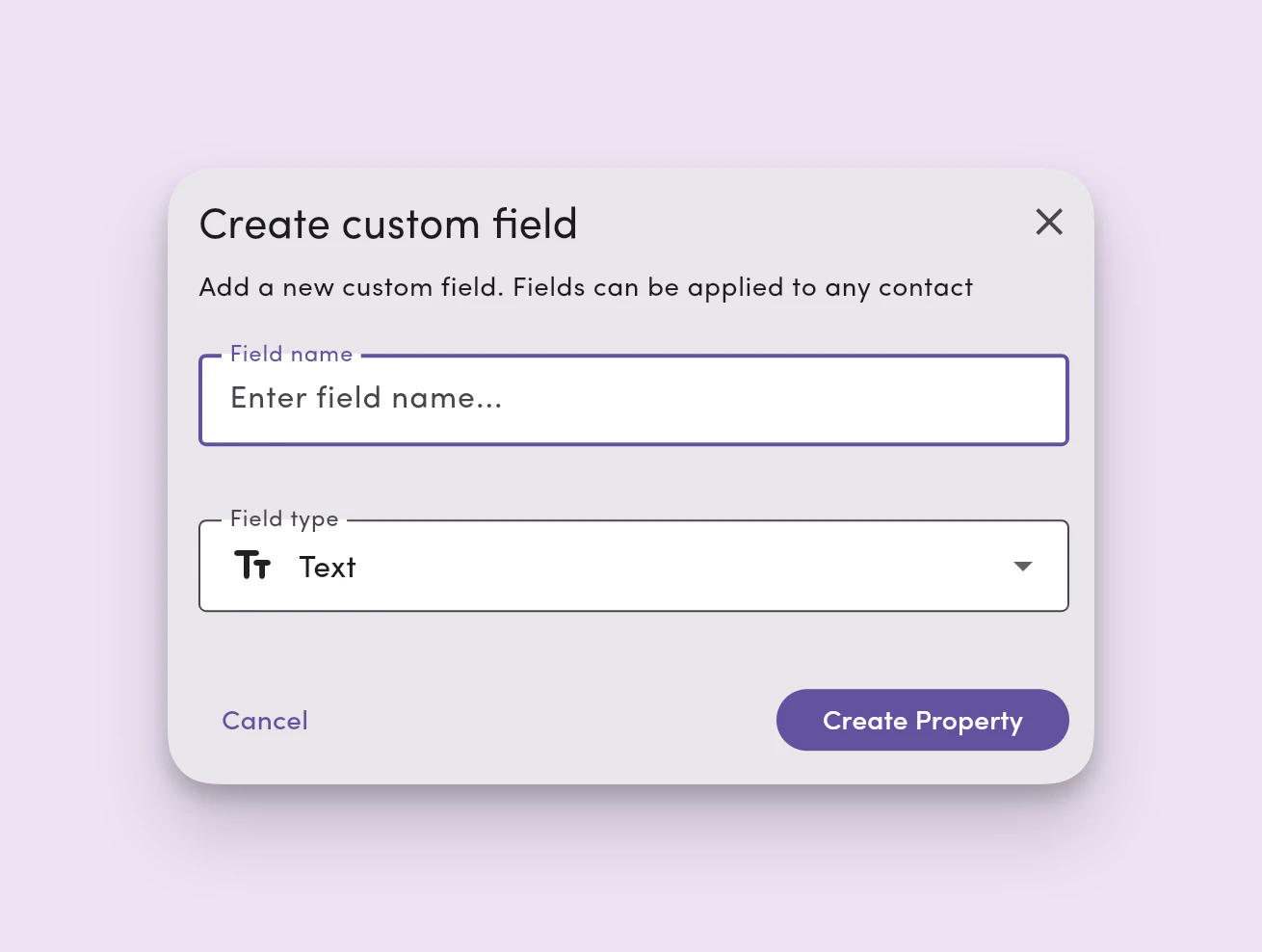
- Click Create Custom Field.
- Enter a name for the field (e.g., “Customer ID”, “Account Type”).
- Select a field type (see supported types below).
- Click Save.
Supported field types
| Type | Description | Example value |
|---|---|---|
| Text | Free-form text input | "Enterprise" |
| Number | Numeric values only | 12345 |
| Date | Date values | 2026-04-13 |
| True/false | Boolean toggle | true / false |
| Dropdown | Select from predefined options | "Gold", "Silver", "Bronze" |
Edit a custom field
- Go to Settings → Workspace Settings → Custom Fields.
- Find the field you want to update.
- Click to edit the field name or configuration.
- Click Save.
Delete a custom field
- Go to Settings → Workspace Settings → Custom Fields.
- Find the field you want to remove.
- Click Delete.
- Confirm the deletion.
Where custom fields appear
- Contact details. View and edit custom field values on any contact record from the Inbox or Contacts module.
- Contact filters. Use custom fields as filter conditions when filtering contacts.
- CSV import. Map CSV columns to custom fields during contact import. Values must match the field’s defined type.
Permissions
Custom fields access is controlled through roles and permissions:| Role | Default access |
|---|---|
| Admin | Owner (full access) |
| Manager | Editor (create, edit, view) |
| Operator | Viewer (view only) |
| Custom roles | No access by default. Must be granted explicitly. |
Example: send a message to one region
Say you want to message everyone in the West region. First, create a custom field called Region. Then add a region value to each contact, like:- West
- Midwest
- South
- Northeast
Region = West
Save that filter as West Region.
Now you have a reusable contact list. Anytime you need to send a regional update, open the West Region filter, select the contacts in that view, and send your message.
That’s where custom fields pay off. Set them up once, and your team uses them again and again.
Ways to use custom fields
The best custom fields help you answer one question: Who do I need to message together later? Here are a few common ways teams use them.Regional outreach
Create a custom field like Region or Territory. Use it to build saved filters for each region so you can send location-based updates, alerts, promotions, or reminders. Example.Filter contacts where
Region = West, save the filter, then use it whenever you need to send a message to that region.
Multi-location businesses
Create a custom field like Store Location, Office, or Branch. This makes it easy to group contacts by location and send updates that only matter to that site. Example.Filter contacts where
Store Location = Mesa, then send a message about that location’s hours, staffing, or appointments.
Staffing and recruiting
Create fields like Job Site, Candidate Stage, or Recruiter. This helps you organize contacts by hiring workflow and send messages to the right group at the right time. Examples.- Filter
Candidate Stage = Interview Scheduledto send reminders. - Filter
Job Site = Renoto send a site-specific update. - Filter
Recruiter = Alexto see and message one rep’s contacts.
Membership and community groups
Create fields like Membership Type, Campus, Chapter, or Program. This helps you send targeted reminders and announcements without rebuilding lists every time. Example.Filter
Membership Type = Premium to send updates only to that group.
Sales and account management
Create fields like Assigned Rep, Renewal Month, or Customer Segment. These fields help your team stay organized and follow up faster. Examples.- Filter
Assigned Rep = Jamieso one rep can work their own book of business. - Filter
Renewal Month = Juneto send proactive renewal reminders. - Filter
Customer Segment = Enterpriseto send messages to a specific account tier.
Best custom fields to create first
If you’re not sure where to start, begin with fields that help you segment contacts and act on that segment later. Good first custom fields include:- Region
- Location
- Customer type
- Status
- Assigned rep
- Renewal month
- Membership type
- Lead source
What makes a good custom field?
A good custom field is easy to understand, easy to keep updated, and useful for filtering.Good custom field
Region Why it works:- Clear values.
- Easy to assign.
- Easy to filter.
- Useful for saved lists and messaging.
Less useful custom field
Notes from trade show conversation Why it’s less useful:- Too inconsistent.
- Hard to filter cleanly.
- Not ideal for building reusable contact groups.
Tips for setting up custom fields
Keep your custom fields simple.Use consistent values
If one contact saysWest and another says Western Region, your filters won’t be as useful.
Pick one format and stick with it.
Create fields your team will actually use
Don’t create fields just because you can. Create fields that support a real workflow.Think ahead to filtering
Before you create a field, ask: Will I want to group contacts by this later? If the answer is yes, it’s probably a good custom field.Start small
You don’t need to create everything at once. Start with one or two fields that support your most common messaging workflows.Common workflow: from custom field to message
A simple way to think about it: Custom field → Filter → Saved list → Message For example: Region → West → West Region → Send update to West contacts Your team doesn’t have to rebuild the audience every time. That saves time.When to use custom fields vs. labels
Use custom fields when you want structured contact data that you can filter by later. Use labels when you want a more flexible way to tag or organize conversations.Use a custom field when:
- The value should live on the contact record.
- The field should stay consistent.
- You want to filter and build reusable lists from it.
Use a label when:
- You need something lightweight and flexible.
- The grouping is temporary or less structured.
- You don’t need a formal field on the contact.